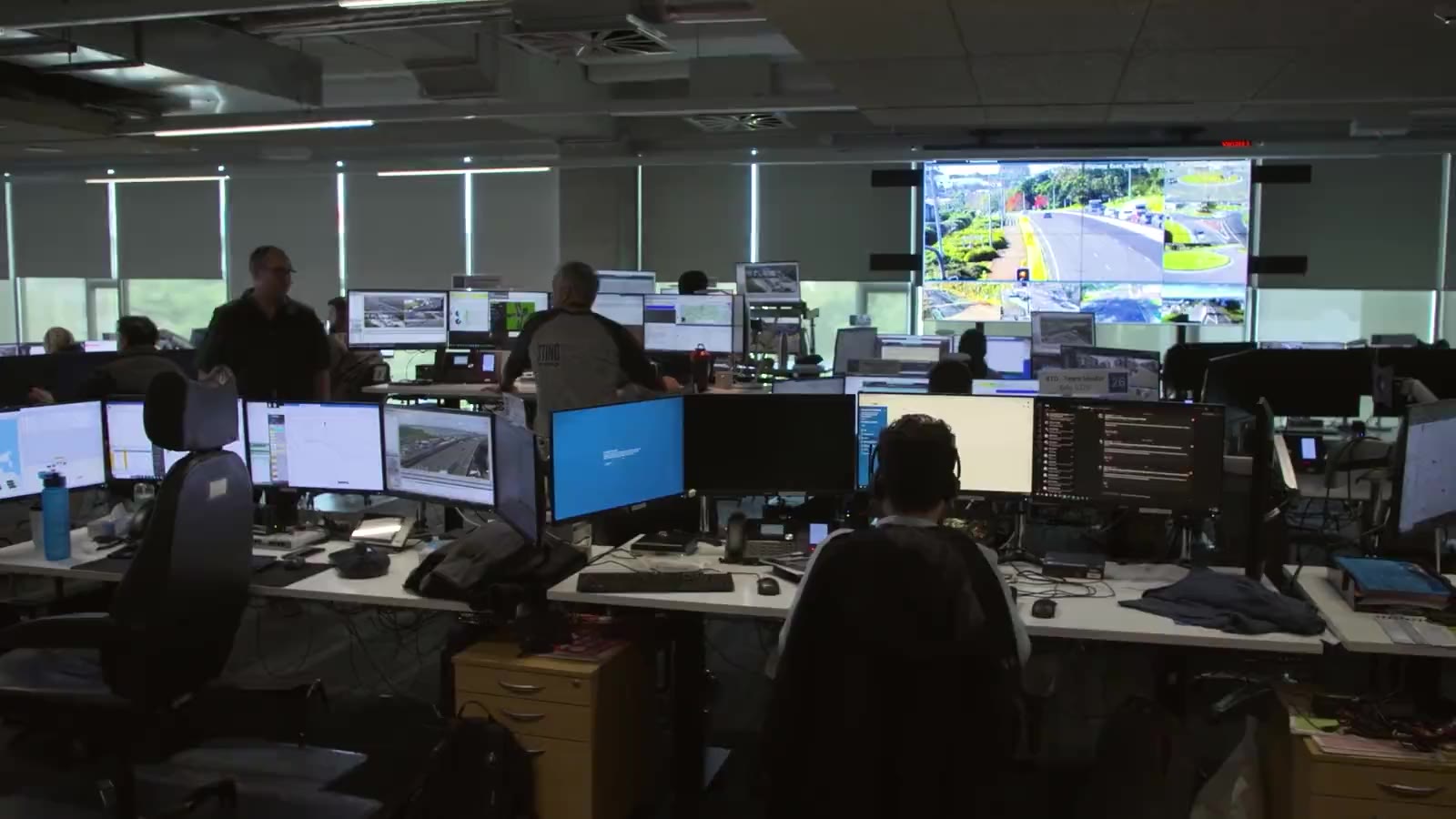
2:27 · captions on by default · narrated by a synthetic voice · the full transcript is printed further down this page. The film says nothing the site does not say in writing.
What it covers
Each button jumps the player to the second that line begins. The times are the measured lengths of the narration clips, not estimates.
Transcript
The complete script, verbatim. This is the same text the captions carry and the same text the narration was generated from — printed so that the film is readable with the sound off, and so that every word it speaks has been through the same checks as every word on the site.
THE EXECUTIVE FINDING0:00
Election Command is one election-operations platform, not sixty separate applications. Sixty-eight domain modules sit on ten shared and hardened services — identity, evidence, audit, jurisdiction rules, offline sync — built once and used by all.
THE EVIDENTIARY SPINE0:16
LockChain is the evidentiary spine. Every operation emits a canonical event: who acted, in what role, on which device, at what time — chained by hash to the event before it, under a signed receipt.
THE DOCTRINE0:29
The doctrine is one sentence. LockChain proves provenance, sequence, integrity and accountable handling. It does not manufacture truth.
THE WORD WE USE0:38
So we say tamper-evident. Never immutable. Cryptography can show that recorded bytes have not been altered. It cannot show that a statement inside them is true.
WHAT DEFEATS IT0:48
And we name what defeats it. A privileged attacker holding every database, key, checkpoint and backup could fabricate a replacement history. So keys, checkpoints and backups are held apart from the application.
THE CRITICAL DESIGN RULE1:01
One rule carries the record. A historical event is never edited to fix it. A correction is a new event pointing back at the one it corrects — the original survives, and the history stays legible.
THE EVIDENCE LADDER1:12
Findings climb a ladder. Data. Observation. Allegation. Anomaly. Evidence. Finding. Conclusion. Machines may work the lower rungs. A named human is accountable for the top.
WHAT THE SOFTWARE MAY SAY1:24
So the software may say: expected seal value differs from observed value. Review required. It may never say fraud. That word belongs to authorities and due process, not to a comparison of two strings.
AUTHORITY RESOLVES IN ONE DIRECTION1:37
Authority resolves in one direction. Arizona law and the state's Elections Procedures Manual control the procedure. NIST, the Election Assistance Commission and CISA inform the safeguards — not the other way round.
OFFLINE IS MANDATORY1:50
Offline is mandatory, not a degraded mode. A polling place with no signal still opens, still runs its checklist, still records custody.
TWO DIFFERENT FACTS1:59
And a yellow saved locally must never look like a green received by county command. Those are two different facts, and the screen must keep them apart.
THE BOUNDARY2:08
One boundary is absolute. This sits beside voting systems, never inside them. No connection to a tabulator, no control channel, and no voter selections at all.
CLOSING2:18
That is the design. Build the hard parts once. Append, never overwrite. Say what is proven, and say plainly what is not.
How it was made, and what is synthetic
The voice is generated. The words are not. The narration is text-to-speech — Laura (ElevenLabs, US English) — reading a script written for this film. No real person is depicted or impersonated, and no human recorded it. The words were written before the voice existed and are printed above in full.
The picture is cut to the voice
The narration was rendered first, one clip per line, and every clip's real duration was measured off the encoder. Each scene is then exactly as long as the line it carries plus the crossfade. Scene lengths run from 8.4s to 16.7s because the sentences do, and the 370 words of script were never once assumed to fit a picture. A script's guess at how long a line takes to say is always short, and a line that overruns lands under the wrong picture.
One overlapped timeline
Scenes cross-fade straight into one another over 0.8s. There is no fade to black at any cut — that is what makes a film feel like it has dead air between every scene. Chaining crossfades also shortens a timeline, which is how a closing line gets cut off, so every segment is built longer than its narration by exactly the crossfade. Measured result: 147.1s of voice inside a 148.0s film.
Every word transcribed back
Text-to-speech drops and slurs words silently, and nothing in a render complains. Every clip was transcribed back with a local speech-to-text model and diffed against the script: 13 of 13 clips transcribed back · worst 100.0% word coverage · 0 under the 95% floor. Two lines failed the first pass — hash-chained came back as “has chained” and edit a came back as “added a” — so both were rewritten until the elision was impossible, and re-rendered.
The footage is the site's own
Six silent, seamless loops, licensed from Pexels and credited by photographer on the credits page. They are graded down and used as ground for the type; none of them is a recording of an election, a polling place, a ballot or an election worker, and none should be read as one. The on-screen words are drawn from this site's own pages.
What the build checks before this page can ship.
test/gate-film.mjs opens the finished file rather than the build log: that the picture
is h264 / yuv420p / 1920x1080, that an audio stream exists and is not silent, that its
sample rate is the intended 44100 Hz, that the film is within 1.5s of its own narration so
nothing was eaten, that no black frame sits between any two scenes, that the caption file parses
and its cue count matches the script line count and every cue is the script line verbatim, and that
the bottom tenth of the poster carries no ink at all — because a video control bar covers exactly
that band, and a poster is the one still a reader decides on. Each of those checks has been made to
fail on purpose.
The film is an explanation of a written blueprint. It names no customer, no jurisdiction that has adopted anything, no certification and no date of any pilot, because there are none. Where it names an authority it names it as the authority that controls the procedure, not as an endorsement of this software.